
 日本語
 Español
 한국어
 简体中文
 Português
 Français
 Deutsch
 Italiano
 ไทย
 العربية
 Polski
 Bahasa Indonesia
 Türkçe
 हिन्दी
 বাংলা
 Русский
 Tiếng Việt
 Nederlands
 Svenska
 Dansk
 Norsk
 Čeština
 עברית
 Filipino
 Bahasa Melayu
Card recognition software that identifies, grades and prices cards in bulk
Everything Cardloader does, and what each engine can and cannot do. Free local AI for sorting, the Ximilar API when you need exact matches, prices and grades.
Offline card recognition on your own computer
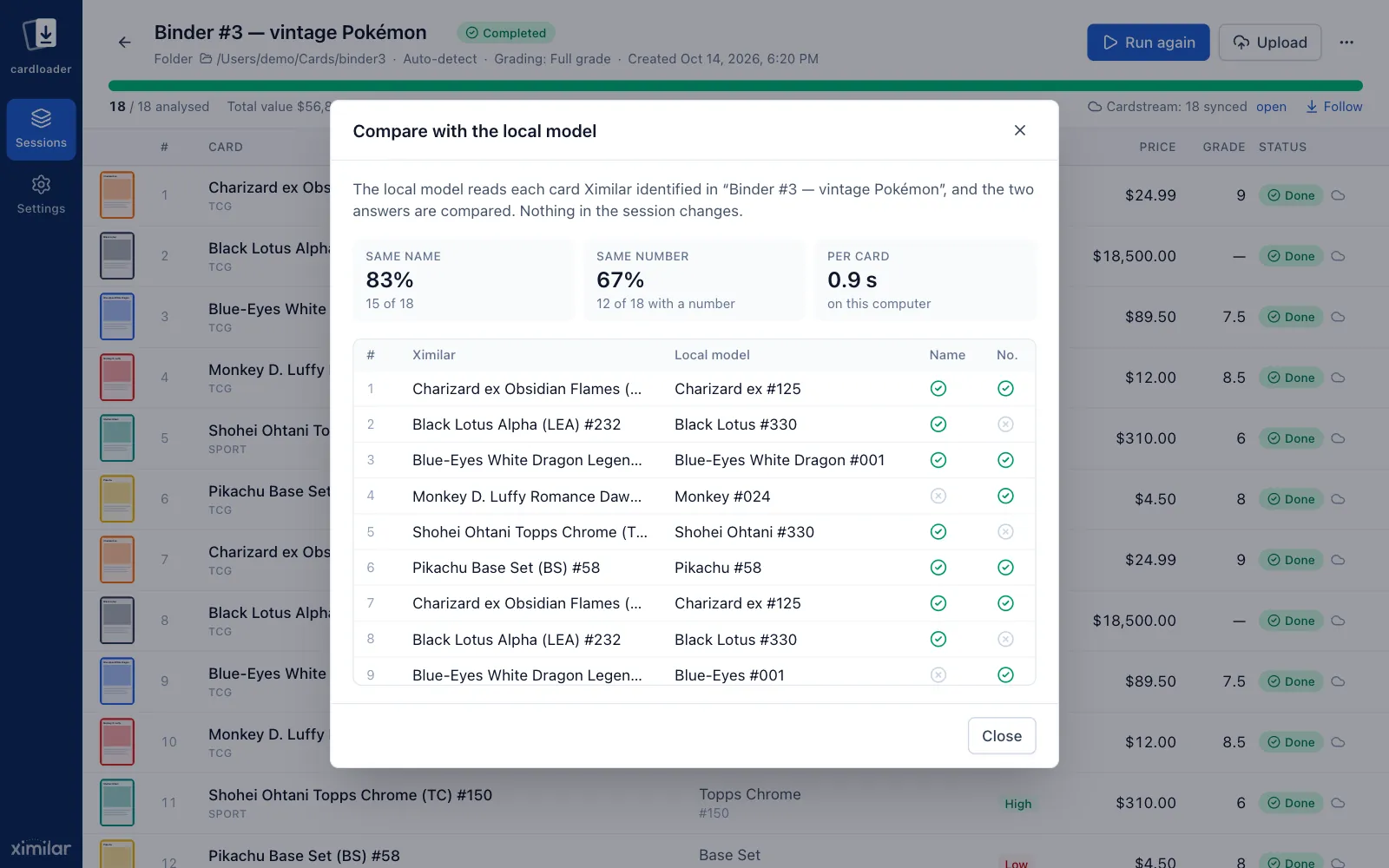
Cardloader includes an on-device engine built on LFM2.5-VL 450M, a small vision language model by Liquid AI, running through llama.cpp. It uses Metal on Macs and the CPU on Windows and Linux, and takes about a second per card on a recent laptop.
Each card gets two quick looks: the whole card for its name, year and game, and an enlarged strip of the bottom edge for the collector number and set code. Answers are held to a fixed JSON shape, so they always parse into clean columns.
- Free and unlimited: no API key, no account, no per-card fees.
- Private: images are read on your machine and never uploaded.
- One-time download: about 330 MB from Hugging Face after you accept the model’s license; it can be paused and resumed.
- Honest limits: it cannot tell reprints and variants apart, and gives no match score, alternative candidates, prices or grades. Rows show a Local tag instead of a confidence tier.
The model is licensed under the LFM Open License v1.0, which limits commercial use above a revenue threshold. Cardloader itself is Apache-2.0.
AI card identification with exact matches and prices
For the most accurate results, a session can use the Ximilar Collectibles Recognition API. In Auto mode, each card is first classified and then sent to the right endpoint: TCG ID, Sport ID, Comics ID or Slab ID.
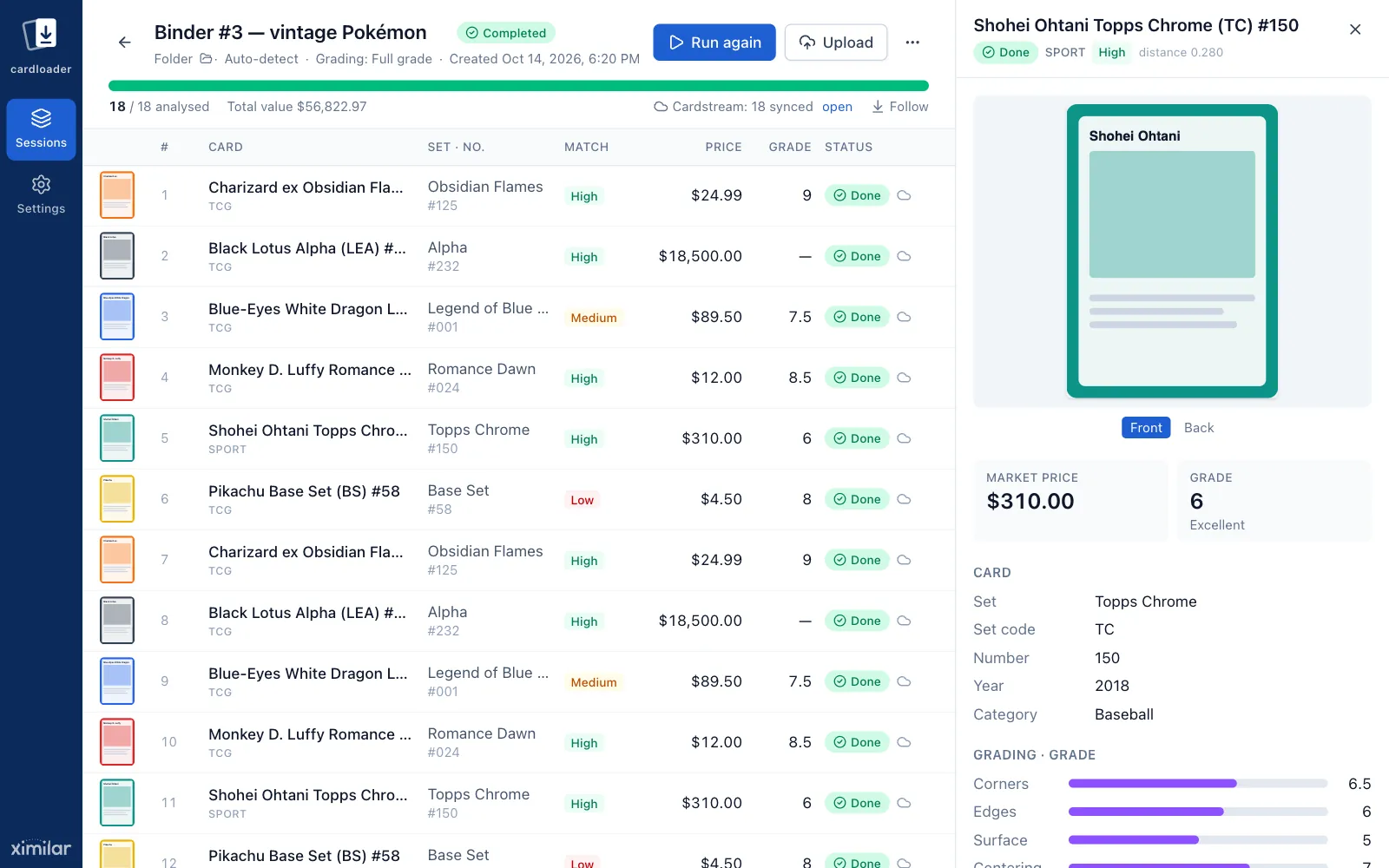
- Confidence tiers: every match is marked high, medium or low, so you review only the uncertain cards.
- Alternative candidates: if the best match is wrong, pick another one with one click.
- Price statistics: a representative USD price with links to marketplaces such as TCGplayer and eBay.
- Pay per use: one API call per recognition (two in Auto mode). Needs a Ximilar Business plan or trial; see Ximilar pricing.
Card grading, condition and centering
With the Ximilar Card Grading API, Cardloader can pre-grade every card in a batch before you decide what to send to PSA, BGS or CGC. Grading overlays are saved with the session so you can see exactly what was measured.
- Full grade: corners, edges, surface, centering and a final grade, using both sides of the card.
- Condition: a fast condition check on the eBay, TCGplayer, Cardmarket or Ximilar scale.
- Centering only: a centering score from both sides, for a quick sort before grading.
TCG, sports cards, comics and graded slabs
One scanner app for the whole collection. These are the categories the Ximilar API recognizes; the local model reads the printed text of any card.
Pokémon card scanner for PC and Mac
Identify Pokémon cards in bulk, including set and collector number, from a folder of scans or straight from the scanner.
Magic: The Gathering, Yu-Gi-Oh!, One Piece and Lorcana
The same flow covers the major trading card games, and more are added to the Ximilar API over time.
Sports card scanner software
Baseball, basketball, football, soccer and hockey cards, identified by name, set, year and card number.
Comics and graded slabs
Comic books are identified with Comics ID, and graded slab labels from PSA and other graders are read with Slab ID.
Bulk card scanning: scanner, folder or watch folder
Cardloader takes cards from wherever they are. Original images are never modified or moved.
- Document scanner: drives a RICOH/Fujitsu fi-8170 (or any TWAIN 2.x scanner with a feeder on Windows, any SANE scanner on macOS and Linux) in ADF duplex batches, at 600 dpi by default.
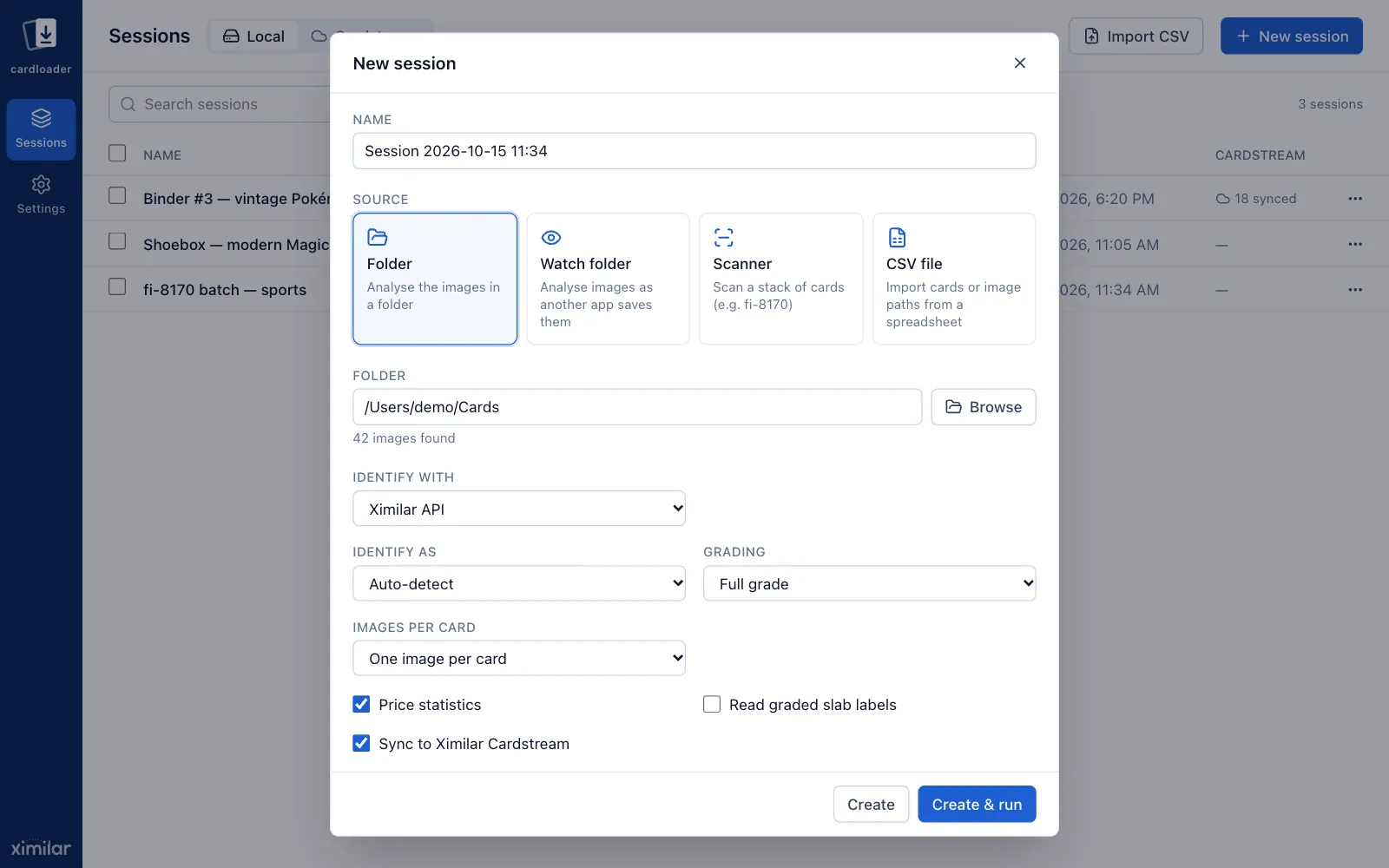
- Folder: analyse JPG, PNG, WebP, TIFF or BMP images from a folder of scans or phone photos.
- Watch folder: analyse images as another app saves them, for example PaperStream Capture or ScanSnap Home.
- CSV file: import an existing spreadsheet; rows with an image path are analysed, rows with a card name come in as identified.
Automatic front and back pairing
Choose one image per card or front and back pairs. Files are paired by name (front/back, recto/verso, f/b, a/b), or in order when they have no such suffix. Duplex scans from the scanner are paired for you.
Sessions you can pause, resume and fix
Every folder analysis or scanner run is a session stored on your computer.
- Results fill in live; click a card to see its images, match, price and grade.
- Pause, stop and resume, even after restarting the app. Retry failed cards one by one.
- Run again picks up new files added to the folder since the last run.
- Up to 16 cards analysed in parallel for fast bulk scanning.
- Search, filter, rename, duplicate and bulk-delete sessions.
CSV export and import for your inventory
Export any session to a UTF-8 CSV that opens in Excel, Google Sheets or your store’s import tool. Columns include name, set, set code, card number, series, year, category, confidence, price in USD, grade, condition and the image paths. An exported file imports back exactly as it was.
Optional sync to Ximilar Cards Cloud
Mirror sessions live to Ximilar Cards Cloud, with each card’s image, match, prices and grading, and browse what is stored there from the Cards Cloud tab. Corrections you make in Cardloader are sent along. Sync is off unless you turn it on.
Open source: adapt it to any collector use case
Cardloader is released under the Apache-2.0 license. Read every line, run it anywhere, and fork it for whatever you collect: coins, stamps, sealed product or your own card database.
It is built with Tauri 2 (Rust) and React with TypeScript, stores sessions in SQLite and keeps your API key in the system keychain. Sources, engines and the CSV export each live in their own module, with tests that include an end-to-end run against a mock API.
Start scanning your cards for free
Download Cardloader for Windows, macOS or Linux, point it at a folder or your scanner, and identify your first batch in minutes. No subscription, no account.